Dohadwala Rashida Taher will be conducting a workshop on the use of paper strips and quilling to make eco-friendly jewellery on 28 July, 2.45pm – 3.30pm at *SCAPE Workshop, Situation Room (Level 5).
Rashida shared that her inspiration for quilling came from a book which she saw 8 years ago, and it gained traction over the years. Her inspiration for projects come from many sources ranging from the colourful flowers at the Sentosa Spring Festival to the beauty of a peacock’s plumage to the popular “Angry Birds”. She shared that once the quilling fever sets in, everything around her seems to inspire a quilling project. She has made gift tags, envelopes, photo frames, paper jewellery, magnets, candle holders, greeting cards and even incorporated quilling into decorative watches!
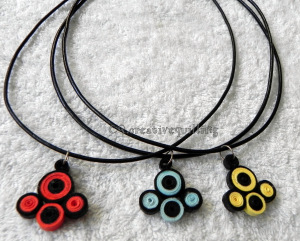 In her workshop, she will share the original quilling technique where participants will make a colourful pendant which will be attached with a leather string to form a necklace, and the project will be suitable for any children aged 7 and above. The finished creations can be brought home by the participants. The quilled items can be made water resistant but this process requires multiple coats with a drying period of about 2 -3 days and cannot be completed during the workshop. Hence, Rashida is offering participants of the workshop to waterproof their end products and collect from her separately at centrally located MRT stations on either 1st or 2nd August.
If you are interested to learn how to quill and make your own fancy jewellery with it, do come to the Singapore Mini Maker Faire on 28 July and sign up for the workshop at the SMMF information counter. The fee is at $8 per participant. Places are limited, so come early to secure your places!
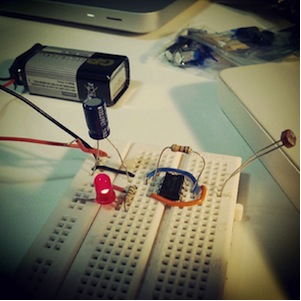 The idea is to use a kit (which will be provided) to build a simple circuit which blinks faster or slower depending on brightness of the ambient lighting.
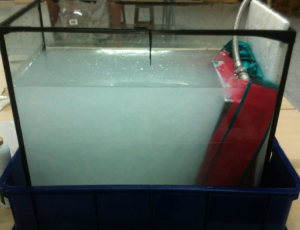 “I have been developing a water purification device that uses an ultrasonic transducer to generate standing sounds waves within the tank, acting as the mechanism for purification. The standing wave results in the formation of node (minimal vibrations) and antinode (maximum vibrations) points. As node points are the points of minimal vibration, sedimentation and other impure substances move towards this point from the antinodes, as it would be the point of maximum stability. As the impure particles move towards the node points, they are held stationary and begin to aggregate together. They become denser as a result and settle at the bottom of the tank for purification.”